Tiletris
Falling letters, spelled words
Spell words, build your deck
A word deckbuilder. Spell words from your rack, collect star cards that bend the rules, and beat the letter bosses from A to Z.
Free to play, supported by ads. Calembour privacy policy · Terms of Use
Word definitions adapted from Wiktionary (via kaikki.org), available under CC BY-SA 3.0.
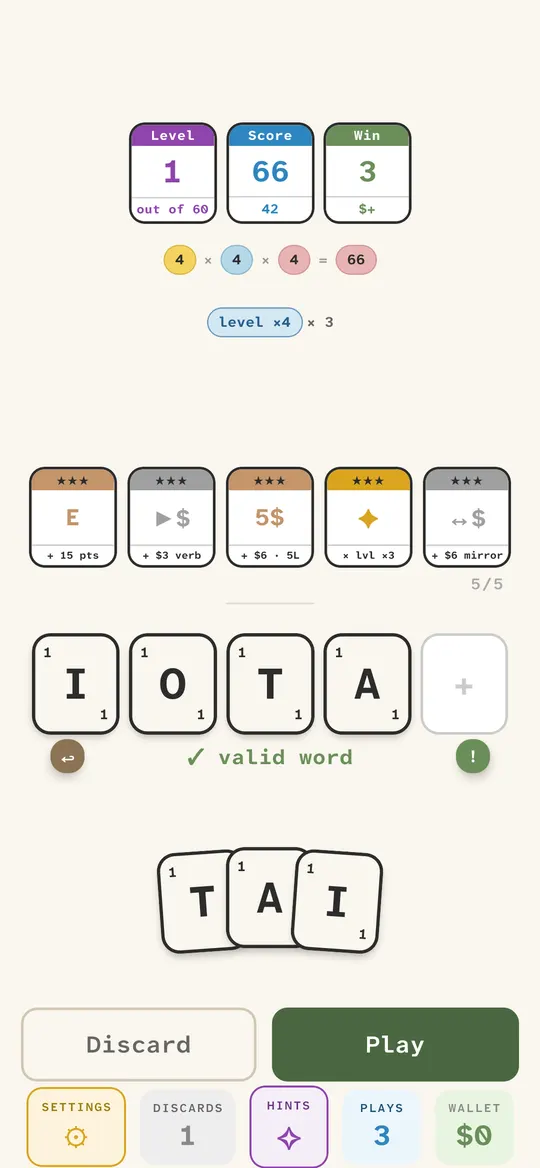
Calembour is a word game played as a run. Each level gives you a score target and a small number of plays. You hold seven letter tiles; spell a word with some of them, play it, and the word's score goes toward the target. Your hand refills after every play. Reach the target before your plays run out and you move on. Run out first and the run ends.
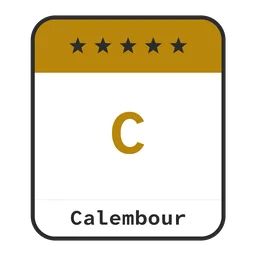
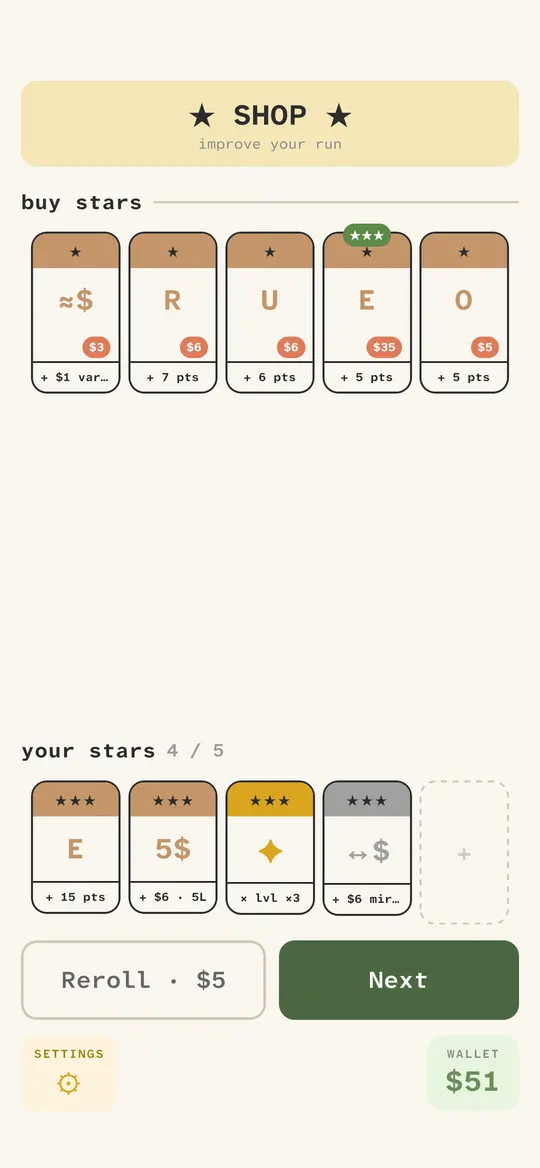
Between levels you visit a shop and spend the cash you've earned on star cards. A star card changes how words score for the rest of the run: extra points for every R, a multiplier for words with a K, a bonus for nouns, cash for every palindrome. You can hold five different star cards, and buying the same card again stacks it, up to ten copies.
A word scores the sum of its letter values, times its length, times your multiplier, plus any flat bonuses from star cards. Length counts twice: a longer word has more letters to add up and a bigger length factor, so a five-letter word is usually worth far more than two short ones.
Common letters like E, A and S are worth little; rare ones like Q, Z and X are worth a lot. Two blank tiles in the bag can stand for any letter.
Star cards add three kinds of value. Points cards add a flat bonus (for example, +12 for each T in the word). Multiplier cards grow the factor everything is multiplied by, which is where the big numbers come from. Cash cards, the ones marked with a $, pay out at the end of the level instead of scoring, so they buy you better cards later.
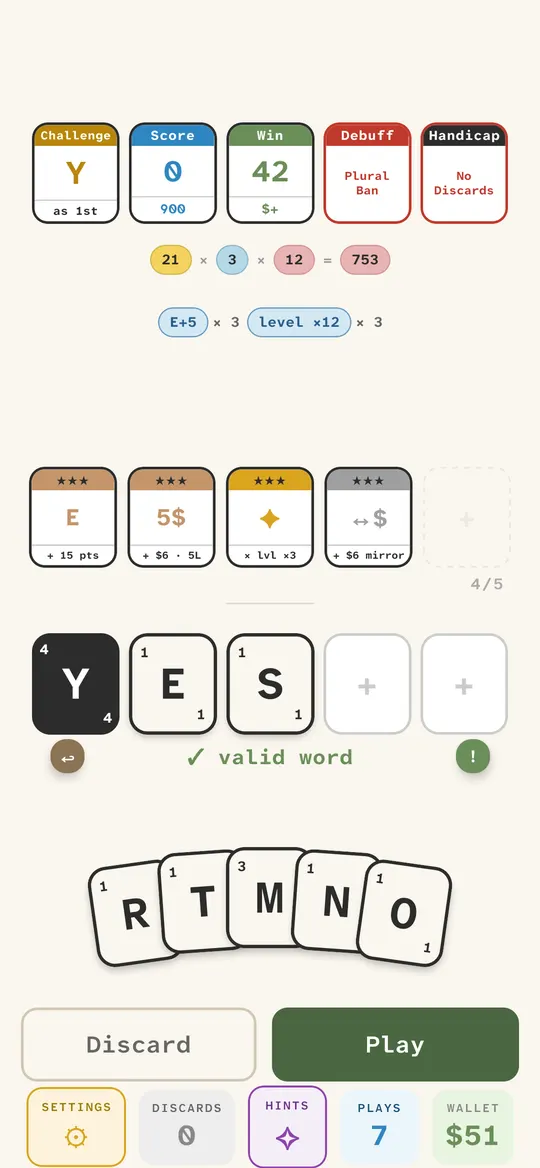
Every few levels a letter boss blocks the road, one for each letter from A to Z. In a boss fight one tile is locked on the spellboard: every word you play must start with that letter. A few letters that rarely start words sit later in the word instead (I and U in second place, X and Z in third).
Every boss except J also brings one rule card, dealt at the start of each run. Debuffs weaken your tiles or words: cursed letters that score nothing, or a ban or tax on a kind of word (nouns, verbs, plurals…). Handicaps change the rules of the fight: fewer discards, words of an exact length, a hand of three or four tiles. Early bosses draw the milder rules and the last ones the harshest. Tap a rule card in the header to read it; long-press it for the full detail. The letter boss guide lists every boss and rule.
The name is French for a pun, and the game started from a simple question: what if every word you know were a card in a deck? Word games usually reward a big vocabulary. We wanted one that rewards planning: knowing that "ZONE" is worth more to your build than "OZONE" because of the cards you bought three levels ago.
Runs are short on purpose. A level takes a minute or two, and the game saves after every word, so you can stop at a bus stop and pick up exactly where you were. Calembour plays in English and in French, each with its own dictionary, and the definitions come from Wiktionary so the strange words teach you something.
Calembour · 10 min read
Calembour letter bosses, A to Z
Twenty-six letter bosses stand between you and the end of a Calembour run. This is when each one appears, how the anchor letter works, every modifier it can carry, and how to beat the hardest.
Calembour · 15 min read
Every star card in Calembour
Calembour has 120 star cards. Here is every one with its tier, price and what it really does, followed by notes on which cards fire most often and when to buy them.
Calembour · 7 min read
Letter values and tile bags in Calembour
How much each letter is worth in Calembour, how many of each tile are in the bag in English and French, and why one five-letter word beats two short ones.